Upcoming
Workshops
Register for one of our many engaging workshops below. Earn AASECT CE credits or register as a community member for a lower rate. You will also find our previous workshop recordings for sale!
Aging Kinky AF Workshop
Aging Kinky AF reframes aging as erotic evolution—especially for Black, Brown, queer, disabled, and sex-working communities. We blend clinical insight, public health, and lived kink expertise to dismantle ageism and center pleasure as resistance. Attendees will learn adaptive strategies for desire, consent, and connection as bodies, roles, and needs shift across the lifespan. Through quick somatic check-ins, workbook prompts, and facilitated dialogue, we model kink-affirming, trauma-informed practice you can use with clients, partners, and communities right now. Participants will leave with language, tools, and a mini “Desire Intimacy Wellness Inventory™️” they can immediately implement in practice.
🎤 Presented By: Jet Setting Jasmine & Dr. Nicole Crawford
👤 Who Is This Space For:
- Both licensed & unlicensed clinicians and clinical interns (social workers, therapists, psychologists)
- Sex Workers and anyone in the adult industry
- Anyone of the general public interested in learning more about kink
🧠 Learning Objectives:
- By the end of the workshop, participants will be able to identify at least three kink-based strategies (such as adaptive power exchange or sensory shifts) for sustaining pleasure and connection across the lifespan.
- Intimacy skills (e.g., social, emotional, sexual) and family dynamics.
- By the end of the workshop, attendees will be able to apply a trauma-informed and body-affirming framework to evaluate and dismantle at least two common myths regarding aging and eroticism in marginalized communities.
- Socio-cultural factors (e.g. ethnicity, culture, religion, spirituality, socio-economic status, family values) in relation to sexual values and behaviors
Accessibility: Zoom offers live captioning. If further accessibility tools are needed please let us know.
Please Note: This workshop will be recorded for sale after.
Financial Trauma & Anxiety in SWers
Money stress isn’t “just budgeting.” For a lot of clients—especially sex workers—it can be trauma, stigma, survival mode, and nervous system activation all tangled together.
In this workshop, we’re talking about financial trauma + financial anxiety in sex workers through a trauma-informed, culturally responsive, sex work-affirming lens. We’ll cover what it can look like clinically (compulsive spending, avoidance, panic, shame spirals, dissociation around money), why it makes sense, and how to intervene without reinforcing harm.
You’ll leave with practical tools you can use immediately: financial narrative mapping, CBT strategies for money-related anxiety, and boundary-setting/communication practice—plus referral considerations and ethical guidance.
Save this if you work with clients who carry money shame. Share with a colleague who wants to offer care that’s actually aligned.
🎤 Presented By: Stephanie Olano
📌 What to Expect:
A grounded, skills-forward space where we name the realities of financial stress without moralizing it.
We’ll cover:
- how financial trauma shows up for sex workers (clinically + systemically)
- trauma-informed interventions you can actually use (not just theory)
- boundary-setting and communication tools (with role-play prompts)
- ethical considerations, referral pathways, and cultural responsiveness
- case examples + reflective moments to integrate what you’re learning
You’ll walk away with concrete language, structure, and tools for sessions—especially when money shame, avoidance, or urgency is running the room.
👤 Who Is This Space For:
This space is for therapists + sexual health professionals who want to support sex workers with care that’s:
- trauma-informed
- sex-work-affirming
- culturally responsive
- practically useful (not just “insight”)
Especially for you if you’ve ever thought:
- “I don’t want to accidentally shame my client when money comes up.”
- “I need better tools than ‘try a budget.’”
- “I want to understand how trauma + financial behaviors connect.”
- “I want to talk about money and safety and agency in the same conversation.”
If you work with clients navigating stigma, survival, debt, irregular income, or financial panic—this will support your clinical toolbox.
🧠 Learning Objectives:
- By the end of the workshop, participants will be able to identify and describe at least five ways financial trauma manifests in sex workers, including compulsive spending, avoidance behaviors, and anxiety, referencing socio-cultural, ethical, and sexual health considerations.
- C. Socio-cultural factors (e.g. ethnicity, culture, religion, spirituality, socio-economic status, family values) in relation to sexual values and behaviors
- By the end of the workshop, participants will demonstrate at least two trauma-informed intervention techniques tailored for sex workers experiencing financial anxiety, including setting healthy boundaries, budgeting strategies, and referral practices, with fidelity to ethical and culturally responsive care standards.
- O. Professional communication skills
Accessibility: Zoom offers live captioning. If further accessibility tools are needed please let us know.
Please Note: This workshop will be recorded for sale after.
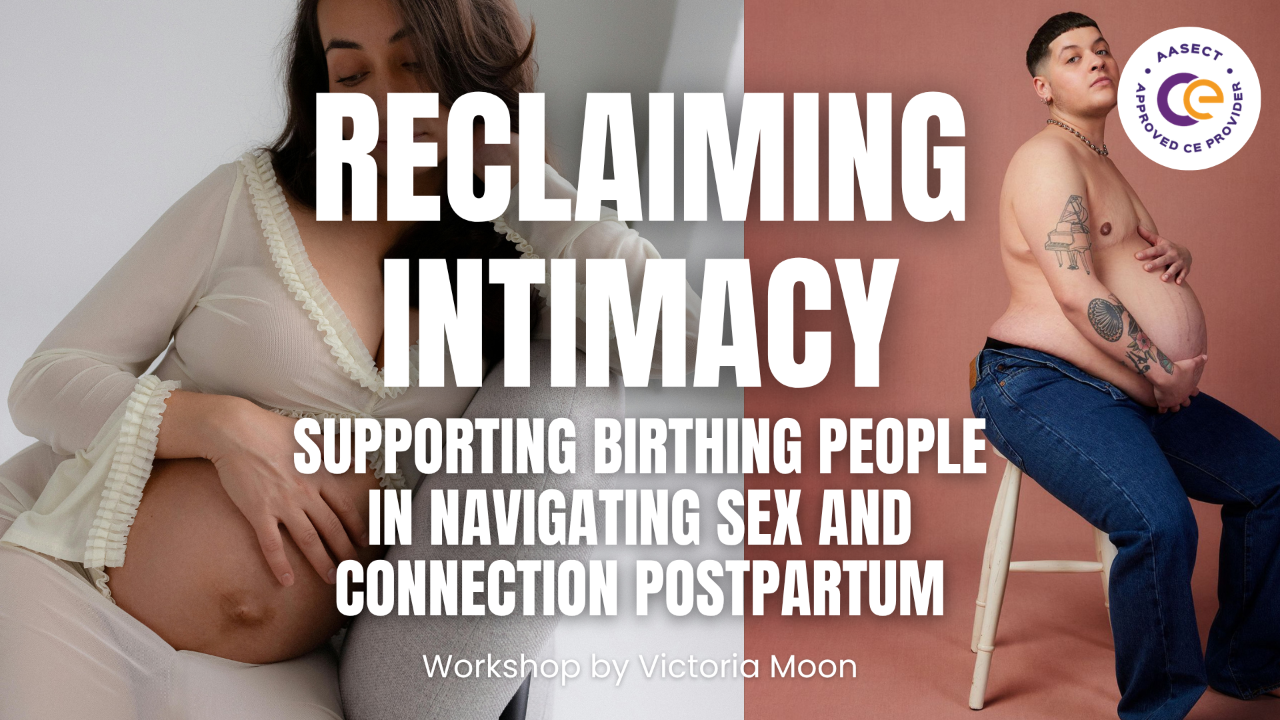
Reclaiming Intimacy Workshop
Supporting Birthing People in Navigating Sex and Connection Postpartum
This workshop explores the intersection of sexuality, intimacy, and postpartum experiences for birthing people, addressing an often overlooked aspect of perinatal wellbeing and relational health. While much attention is given to physical recovery and infant care, many birthing people and their partners are left navigating significant changes in desire, body image, identity, and relational connection with little guidance or support.
Using a biopsychosocial and culturally responsive framework, participants will examine the physiological, psychological, relational, and cultural factors that influence postpartum sexual functioning. The training also considers the impact of race, gender identity, sexual orientation, and societal expectations on postpartum intimacy, with attention to the experiences of queer families, nontraditional partnerships, and individuals whose lives intersect with sexuality and erotic labor.
Participants will leave with practical strategies to ethically, confidently, and compassionately support the rebuilding of intimacy, communication, and connection after childbirth, whether in clinical work or within their own relationships and communities.
🎤 Presented By: Victoria Moon
📌 What to Expect:
- A holistic look at postpartum intimacy, including physical, emotional, relational, and cultural influences on sexuality after childbirth.
- Discussion of common challenges, such as shifts in desire, body image, identity, and partnership dynamics.
- An inclusive and culturally responsive perspective that centers diverse family structures, identities, and experiences.
- Practical tools and strategies for navigating conversations about sex, boundaries, and connection.
- Reflection and discussion to support rebuilding intimacy and communication after childbirth.
👤 Who Is This Space For:
- Birthing people navigating changes in intimacy, identity, desire, and connection after childbirth.
- Mental health clinicians, birth workers, and helping professionals who support individuals and families in the perinatal and postpartum period.
- Partners, loved ones, and caregivers who want to better understand how to support postpartum healing and connection.
- Queer families, nontraditional partnerships, and individuals whose lives intersect with sexuality, including sex workers.
- Anyone interested in learning and growing in this conversation, recognizing that most of us will support someone navigating postpartum life at some point in our communities.
🧠 Learning Objectives:
- By the end of this workshop, participants will be able to identify at least three biopsychosocial factors that influence sexual functioning and intimacy for birthing people in the postpartum period.
- Core Knowledge (b): Developmental sexuality from a bio-psycho-social perspective across the lifespan
- Core Knowledge (h): Health/medical factors that may influence sexuality
- By the end of this workshop, participants will be able to apply at least two counseling or therapeutic strategies to support birthing people and their partners in navigating intimacy challenges postpartum.
- Core Knowledge (e): Intimacy skills (e.g., social, emotional, sexual) and family dynamics
- Sexuality Counseling (c): Theory and methods of different approaches to intervention in relationship systems
Accessibility: Zoom offers live captioning. If further accessibility tools are needed please let us know.
Please Note: This workshop will be recorded for sale after.
Workshop Recordings
Missed one of our workshops? No problem! You can purchase the recording below and still get AASECT CEs.
Workshops Coming Soon
Let's Talk About Consent: Sex Work Edition
Presented by Shawn Vee
July 28 from 4:00-6:00pm Eastern
Emotional Brain: Power, Pathology, and the Policing of Feelings
Presented by Nishita Rao
September 12 from 4:00-6:00pm Eastern
Challenging Orientalism: Confronting the Sexualization of Bellydance
Presented by Nishita Rao
September 26 from 4:00-6:00pm Eastern
Cyber Sexuality & Social Media
Presented by Jupi Bowen
October 24 from 4:00-6:00pm Eastern
DOPE: Daughters of Porn Entertainers
Presented by Jet Setting Jasmine
November 28 from 4:00-6:00pm Eastern